What Are Wine Attributes? 5 Main Types
Navigating a wine list shouldn’t feel like deciphering an ancient manuscript. Think of a bottle’s core structural traits as its personal dating profile, a candid blueprint revealing precisely what you are getting yourself into before the cork even pops.
By understanding a few structural pillars, you can effortlessly decode a wine’s personality without a sommelier badge.
Here is how to read between the lines:
Sweetness vs. Dryness
This trait spans a vast spectrum, ranging from bone-dry vintages that offer zero residual sugars to luscious, nectar-like pours that drink like liquid dessert. It is all about the initial impression on the tip of your tongue.
Acidity
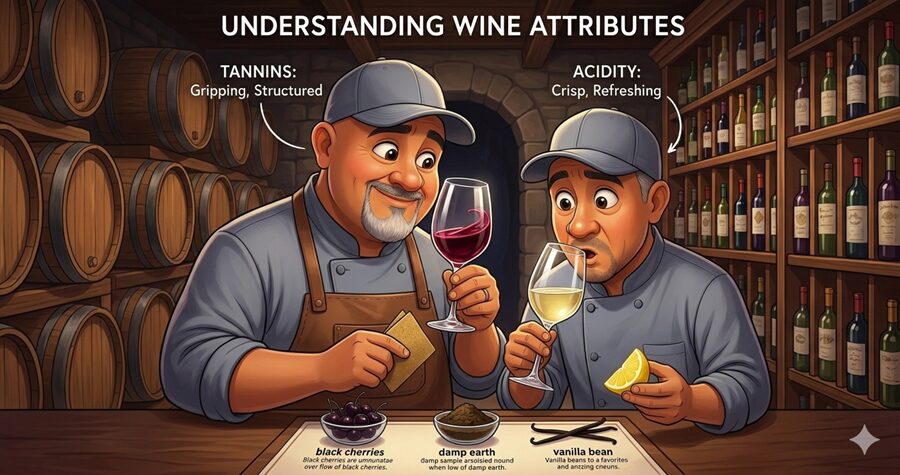
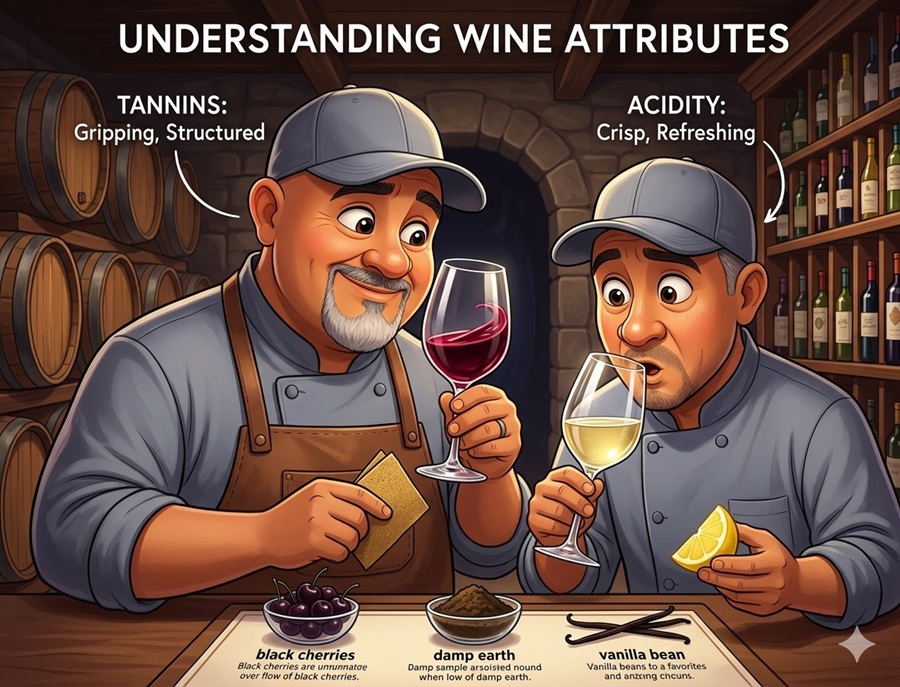
Acidity acts as the nervous system of a wine. It is that vibrant, mouth-watering electricity that makes your jaw pucker up and leaves you craving another bite of food. Without it, a wine tastes flat and lifeless; with it, the entire glass wakes up.
Tannins
Predominantly found in red varieties, tannins are naturally occurring polyphenols derived from grape skins and oak barrels. They introduce textural astringency, drying out your palate much like an over-steeped cup of black tea. Tannins provide the structural scaffolding that allows wines to age gracefully over decades.
Alcohol Level
The alcohol content determines the physical weight and invisible heat of the wine. As you swallow, it manifests as a creeping warmth in the back of your throat. Higher alcohol often translates to richer textures and a bolder presence.
Body
Body describes the overall viscosity and weight of the liquid on your palate. It is a sensory scale easily understood through a simple dairy analogy: light-bodied wines feel delicate and fleeting like skim milk, medium-bodied pours mirror whole milk, and full-bodied showstoppers possess the rich, coating density of heavy cream.
By assessing how these fundamental elements interact, you can instantly grasp a bottle’s unique identity and flavor profile long before the first sip.
When you hear folks talk about their wine tasting, you’ll hear these 4 main tasting attributes.
Let’s strip away the stuffy, velvet-jacketed lecture and get down to the brass tacks of pouring something into your glass that won’t make you instantly regret your life choices. Navigating the wine aisle as a newcomer is a minefield of intimidating labels and snobby jargon.
To help you skip the existential dread, look at a bottle through the lens of four non-negotiable attributes. They will serve as your ultimate cheat sheet for picking a spectacular beginner-friendly bottle without breaking the bank.
Attribute 1: Low Tannin and Moderate Acidity (The “Smoothness” Factor)
When someone strolls into a wine shop and asks for something “smooth,” they are rarely looking for structural complexity. They are desperately pleading for a drink that won’t assault their taste buds. In the wine universe, smoothness is governed by a delicate truce between two major elements: tannins and acidity.
What Exactly Are Tannins?
Tannins are organic polyphenols found natively in grape skins, seeds, and stems. To understand them without taking a sip, think of the last time you left a bag of cheap black tea steeping in a mug for an hour. That furry, moisture-sucking, tongue-cleaving sensation that made your mouth feel like it was stuffed with cotton? Those are tannins doing their job.
The “Sandpaper” Dilemma vs. Velvet Textures
For the uninitiated, diving headfirst into a high-tannin monster like an aggressive, youthfully brash Napa Cabernet or a heavyweight Italian Barolo feels less like luxury and more like gargling liquid sandpaper.
Instead, a stellar starter bottle actively avoids the grip. Look toward varietals that behave like liquid silk:
- Pinot Noir: Elegant, bright, and practically glides across the palate.
- Merlot: Plump, forgiving, and velvety.
- Gamay: Light-bodied, playful, and incredibly gentle on your gums.
These grapes bypass the aggressive dry-out, allowing your mouth to actually enjoy the scenery while your palate gets its training wheels dirty.
Goldilocks Acidity: Finding the Sweet Spot
Acidity provides the “zap” or electrical current running through a wine. It is the component responsible for making your mouth water.
- Too low: The wine becomes “flabby,” a tragic, syrupy state of existence akin to drinking a warm, flat fountain soda.
- Too high: It mimics the joy of biting directly into a wedge of raw lemon, threatening to reward your curiosity with immediate, raging heartburn.
For a gentle introduction, you want moderate acidity. It delivers just enough crispness to keep things refreshing and alive, without forcing you to reach for an antacid before the glass is empty.
Attribute 2: Clear, Punchy, Fruit-Forward Profiles
We have all been there: you stick your nose deep into a wine glass, take a dramatic sniff, and think, Yup, smells exactly like fermented grape juice. Do not panic. Developing a nose for subtle nuances takes time. However, you can give your brain a massive head start by leaning into “fruit-forward” styles.
Why “Fruit-Forward” Beats the Funky Stuff
In the sprawling landscape of viticulture, many highly praised, expensive bottles smell like things you wouldn’t necessarily want to eat: damp forest soil, wild mushrooms, old leather, or stable floors (yes, really). If you are just starting out, that kind of rustic funk can be deeply off-putting.
Fruit-forward wines speak an intuitive, universal language. If a back label promises “ripe wild blackberries,” and your brain instantly registers hey, that actually tastes like blackberry jam, you build immediate confidence. You begin to trust your own sensory organs rather than relying on a sommelier’s manual.
Bottles That Shout Their Identity
Beginners should seek out wines that absolutely scream what they are.
- New Zealand Sauvignon Blanc: A legendary crowd-pleaser because it does not hide. One sniff delivers unmistakable blasts of passionfruit, ruby grapefruit, and freshly mowed grass.
- California Zinfandel: A bold red that frequently boasts an unapologetic, juicy personality reminiscent of raspberry preserves.
These explicit, vibrant flavor signals turn a regular evening into an engaging experience rather than a stressful guessing game.
Attribute 3: Balanced Sweetness and Soft Dryness
The ancient “sweet vs. dry” debate is precisely where most wine journeys stall out out of sheer confusion. Human biology wires our brains from infancy to crave sugar; it is a basic survival mechanism. But while sprinting straight to syrupy dessert pours feels safe, it can permanently mask the authentic character of the grape.
Sidestepping the “Sugar Bomb” Trap
There is absolutely no shame in loving a crisp, fizzy Moscato d’Asti on a hot patio. However, relying entirely on sugar-heavy profiles can stunt your palate’s growth.
The smartest beginner wines occupy a beautiful middle ground known as off-dry. These bottles possess an aromatic, perceived sweetness driven by incredibly ripe fruit notes rather than heaps of actual residual sugar. It keeps the liquid completely refreshing without making you feel like you are drinking spiked fruit punch.
The Magic of “Soft Dry” Grapes
A “soft dry” wine is the ultimate secret weapon for a novice. On paper, these wines are technically dry (meaning the yeast consumed all the sugar during fermentation). Yet, because the tannins are remarkably low and the fruit profile is incredibly plush, the brain interprets the texture as inherently sweet and smooth.
This category is where heavy-hitters like Argentine Malbec or Italian Barbera truly dominate. They serve as a brilliant bridge into the expansive world of dry reds, entirely bypassing the harsh, astringent bite that terrifies most casual drinkers.
Attribute 4: The Power of Financial Sanity
Let’s establish a foundational rule to live by: Never buy an expensive bottle of wine if you are just starting out. Drop the guilt. Spending $80 on a historic Bordeaux is a spectacular waste of money if you take two sips at home and realize you absolutely loathe the prominent taste of charred French oak.
The $15–$25 Sweet Spot
In the modern market, the value-to-quality ratio found between $15 and $25 is absolutely magnificent. When you shop in this pricing corridor, you are successfully stepping away from mass-produced, chemically engineered “industrial” box-store jug wines. Yet, crucially, you aren’t paying a premium for a prestigious chateau name or an inflated marketing budget. It is an open, low-stakes playground.
Beware the Sunk Cost Fallacy
If you drop a crisp hundred-dollar bill on a legendary vintage, you will inevitably force yourself to enjoy it out of psychological self-defense. You will sit there nod your head, pretending to love an overly complex vintage just because your wallet took a beating.
That mindset kills curiosity.
Keeping things affordable allows you to fail forward without a hint of guilt. For the price of a single “prestige” label, you can buy three radically different $18 options:
- A crisp, zesty white.
- A chillable, light-bodied red.
- A dry, berry-laden rosé.
This hands-on trial and error is the fastest, most effective way to map out your personal wine DNA.
Your Store-Bound Cheat Sheet
If you are heading out to the shop tonight, ignore the confusing aisle signs and scan labels for these reliable, easy-going crowd-pleasers:
- Pinot Noir: Light, incredibly low in tannins, and bursts with bright red cherries.
- Grenache / Garnacha: Wonderfully fruit-forward, incredibly soft on the palate, and universally wallet-friendly.
- Pinot Gris / Grigio: Crisp, moderate in its acidity, and perfectly thirst-quenching.
- Beaujolais (Gamay): Ultra-low tannins, vibrant berry flavors, and ridiculously easy to drink.
Ultimately, a genuinely “great” bottle is one that you love drinking, even if it costs twelve bucks and features a cartoon animal on the front. Wine should always be an open conversation, never an elitist lecture. Grab a glass, trust your nose, and enjoy the ride.
FAQs
- Does “low tannin” mean the wine is low quality? Absolutely not! Some of the most expensive and sought-after wines in the world, like high-end Burgundy (Pinot Noir), are naturally low in tannins. It’s about the grape variety, not the quality.
- Is “fruit-forward” the same as “sweet”?No. A wine can be “bone dry” (no sugar) but still be “fruit-forward” if it smells and tastes intensely of ripe fruit. It’s about the perception of sweetness from the fruit aromas.
- Should I chill red wines if I’m a beginner? Actually, yes! While “room temperature” is the standard, many light, low-tannin reds (like Beaujolais or Pinot Noir) benefit from 15-20 minutes in the fridge. It makes the fruit flavors pop and the alcohol feel less “hot.”
- Why do some cheap wines give me a headache? It’s often not the price, but mass-production additives or high sugar content. Moving into that $15–$25 “boutique” range often means fewer additives and a cleaner fermentation process.
- What if I don’t taste the “blackberry” or “tobacco” the label mentions? Don’t panic! Everyone’s nose is different. Those descriptors are just guides. If you just taste “red fruit,” you’re doing great. Your ability to pick out specific notes will grow as you try more varieties.
Learn More Right Here…
- Best Wine for Beginners
- Do you like cider? Here’s the Truth
- Best Craft Beer Pairings
- What wine is good with Pork?
- What Makes A Vega Wine?
- Which Beer is best with Alfredo pasta?
- What is WAM BAM Spice?
- Wine with Lam…YES!!
- Pizza and Wine? Really?
- Which Wine With Salmon?
- Typical is Not Typical With Wine and Steak
- Ham Wine All The Time