The Art of Pairing Wine with Salmon
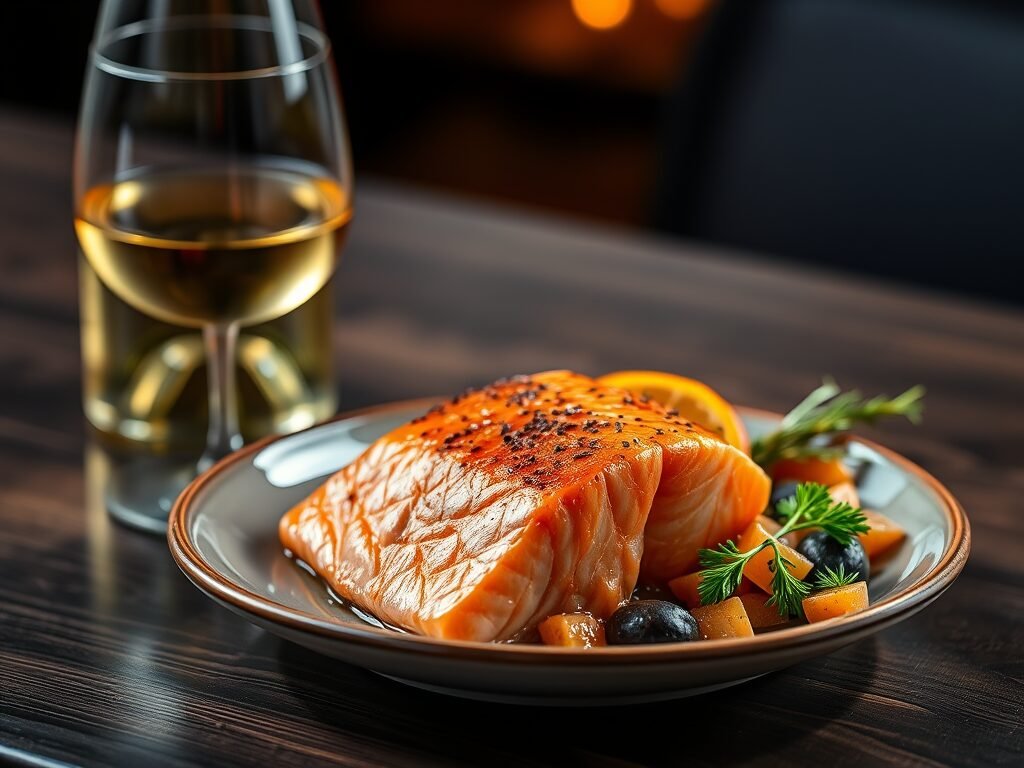
Salmon stands apart from nearly every other protein in the culinary world. Its deep coral flesh, rich omega-3 fat content, and complex flavour profile make it one of the most wine-friendly foods on the table and one of the most rewarding to pair thoughtfully.
Whether you are hosting an elegant dinner party, preparing a weeknight meal, or curating a tasting menu, understanding how wine interacts with salmon’s unique characteristics will elevate every bite and every sip.

Why Salmon Is a Sommelier’s Dream Ingredient
The secret to salmon’s extraordinary compatibility with wine lies in its fat content. Unlike lean white fish such as sole or tilapia, salmon contains substantial intramuscular fat that coats the palate, softens tannins, and creates a lingering finish that calls for wines with genuine body and structure.
This fat acts as a buffer; it can tame the acidity in a crisp white, absorb the gentle tannins in a light red, and harmonise with the oak and butter notes in a barrel-fermented Chardonnay.
Additionally, salmon carries a flavour intensity that most white fish simply cannot match. It tastes of the ocean but also of something richer, more mineral, almost meaty. This intensity means it can stand up to wines that would overwhelm a more delicate fish, opening the door to a far broader range of pairings than most diners expect.
White Wine Classics: The Natural Partners
Chardonnay: The Benchmark Pairing
When we speak of pairing wine with salmon, Chardonnay is invariably the first name to arise and for excellent reason. A well-crafted, barrel-fermented Chardonnay from Burgundy’s Côte de Beaune, California’s Sonoma Coast, or Australia’s Yarra Valley brings a confluence of characteristics that mirror and complement salmon’s own profile almost perfectly.
The buttery texture of an oaked Chardonnay echoes the natural richness of the fish. The wine’s creamy mouthfeel aligns with salmon’s fat, creating a sense of cohesion on the palate rather than competition. Meanwhile, the wine’s natural acidity, never entirely suppressed even in the most luscious examples, cuts through that fat with precision, refreshing the palate between bites and encouraging the next sip.
When salmon is prepared with cream-based sauces — a classic beurre blanc, a tarragon cream reduction, or a dill-infused crème fraîche the case for Chardonnay becomes overwhelming. The wine’s oak-derived vanilla and toasted almond notes weave seamlessly into the sauce’s richness, creating a unified flavour experience that feels deliberately composed.
Recommended producers and regions:
- Burgundy, France — Premier Cru whites from Meursault or Chassagne-Montrachet
- Sonoma Coast, California — Cool-climate Chardonnays with balanced oak
- Yarra Valley, Australia — Elegant, restrained styles with fine acidity
- Mâcon-Villages, France — An accessible, unoaked alternative with bright fruit
White Burgundy Beyond Chardonnay: Chablis and Its Mineral Edge
For those who prefer a leaner, more austere expression, Chablis, the northernmost outpost of Burgundy, delivers something altogether different. Unoaked or lightly oaked, Chablis presents a steely minerality and a pronounced saline quality that makes it a transcendent match for salmon prepared with minimal intervention: simply seared, poached in court-bouillon, or served as gravlax.
The wine’s flint-like character speaks to the oceanic nature of salmon itself. There is an almost geological sympathy between Chablis and seafood that no amount of culinary theory can fully explain; it must simply be experienced.
Viognier: Aromatic Opulence for Spiced Preparations
When salmon is prepared with aromatic spice rubs, miso glazes, or Middle Eastern-inspired marinades, a full-bodied Viognier from the Northern Rhône or South Australia steps forward as an inspired choice. Viognier’s signature apricot, peach, and white blossom notes complement sweet and savoury spice profiles beautifully, while its considerable body matches salmon’s weight without being overwhelmed.
White Rioja and Godello: Iberian Alternatives Worth Exploring
Spain’s contribution to the salmon pairing conversation should not be underestimated. White Rioja, particularly those from Bodegas López de Heredia — offers a unique oxidative, nutty quality that pairs remarkably well with smoked salmon. Similarly, Godello from Valdeorras in Galicia brings Atlantic freshness and a waxy texture that mirrors salmon’s own oceanic character.
Rosé: The Elegant Middle Ground
A dry, structured Provençal rosé or a more robust rosé from Bandol deserves serious consideration when pairing with salmon, particularly at outdoor summer gatherings or when the preparation bridges the gap between the light and the rich.
Salmon tartare with avocado, citrus, and capers finds an ideal companion in a mineral-driven rosé, whose red fruit notes add complexity without overwhelming the dish’s delicacy. Grilled salmon with a herb crust pairs magnificently with a deeper rosé from Bandol or a Grenache-based rosé from southern France, where the wine’s berry notes complement the charred exterior of the fish.
Rosé also excels when salmon is served at a dinner party where guests prefer neither exclusively white nor red wine; it navigates both preferences with considerable grace.
Red Wine Exceptions: When Conventional Wisdom Bends
Pinot Noir: The One Red That Never Fails
The idea of pairing red wine with fish strikes many diners as counterintuitive, even transgressive. With salmon, however, Pinot Noir is not merely acceptable; it is genuinely inspired. The reason lies once again in salmon’s fat content. The fish is robust enough to absorb Pinot Noir’s soft tannins, and its richness is sufficient to carry the wine’s earthy, cherry-driven flavours without conflict.
The key is selecting a lighter-styled Pinot Noir with low tannin, high acidity, and elegant fruit expression. The wines of Burgundy’s Côte de Nuits, Oregon’s Willamette Valley, and New Zealand’s Central Otago are exemplary choices. Avoid bold, heavily extracted New World Pinots, which carry too much tannic weight for even the richest salmon preparation.
The ideal preparation: Pinot Noir achieves its greatest synergy with salmon when the fish is pan-seared or roasted with earthy accompaniments, such as mushroom risotto, lentils, roasted beetroot, or truffle butter. These earthy flavours create a flavour bridge between the fish and the wine, rendering the pairing entirely natural.
Gamay and Beaujolais: A Lighter Red Alternative
For those who desire red wine but want something even softer and more food-friendly than Pinot Noir, Gamay-based wines from Beaujolais particularly cru Beaujolais from Morgon or Fleurie provide a joyful, low-tannin option. Lightly chilled, these wines pair playfully with salmon prepared in Asian-inspired styles, such as teriyaki-glazed salmon or salmon with a ginger and sesame crust.
Preparation Methods and Their Impact on Wine Selection
Raw Salmon: Sushi, Sashimi, and Tartare
Raw salmon in Japanese preparations calls for wines of exceptional delicacy and precision. Sparkling wines — whether a Blanc de Blancs Champagne, a Crémant d’Alsace, or a high-quality Cava cleanse the palate between pieces and complement the clean, clean flavours of the fish. The effervescence acts as a palate refresher, while the wine’s acidity highlights the fish’s oceanic sweetness.
Alternatively, a bone-dry Grüner Veltliner from Austria’s Wachau region, with its characteristic white pepper note and lively acidity, provides one of the most intellectually satisfying pairings for salmon sashimi.
Poached Salmon: Restraint and Elegance
Gently poached salmon, particularly when served with hollandaise or a light lemon-herb sauce, demands a wine of restrained elegance. This is the moment for a village-level Burgundy white, an unoaked Chablis, or a fine Albariño from Galicia. The wine must be present but never dominant — it frames the dish without competing with it.
Grilled Salmon: Smoke, Char, and Bold Wines
Grilling imparts a smoky, charred quality to salmon’s exterior that fundamentally changes the pairing calculus. This preparation calls for wines with greater body and more pronounced flavour, and an oaked Chardonnay gains new relevance here, as do Viognier, Roussanne, and the aforementioned lighter reds. The wine must be bold enough to meet the char without overwhelming the fish’s inherent flavour.
Smoked Salmon: Salinity and Richness
Cold-smoked salmon, the gravlax and lox tradition is among the most culinarily complex preparations, layering salt, fat, smoke, and sweetness simultaneously. This complexity demands wines with textural presence and aromatic interest.
An off-dry German Riesling Spätlese from the Mosel provides a brilliant counterpoint, its residual sweetness balancing the salt while its acidity cuts through the fat. Alternatively, a fine Champagne or a glass of aged white Rioja honours the occasion with appropriate ceremony.
Temperature, Service, and Practical Considerations
The temperature at which wine is served matters enormously when pairing with salmon. Full-bodied whites such as oaked Chardonnay perform best at 12–14°C, cool enough to preserve freshness while allowing their aromatic complexity to fully express itself.
Lighter whites and sparkling wines should be served colder, at 8–10°C. Light reds like Pinot Noir and Gamay benefit from a slight chill between 14–16°C, which accentuates their freshness and reduces the perception of tannin.
At the dinner table, glassware plays a supporting but meaningful role. A generous, tulip-shaped bowl for full-bodied whites allows the wine to breathe and its aromas to concentrate. Pinot Noir is best served in a wide-bowled Burgundy glass that showcases its aromatic complexity.
Building a Complete Salmon and Wine Menu
For those hosting a multi-course dinner centred on salmon, consider the following progression:
- Smoked salmon canapés — served with a glass of aged Blanc de Blancs Champagne
- Salmon tartare with citrus and capers — paired with Chablis Premier Cru
- Pan-seared salmon with mushroom and truffle butter — accompanied by a village Gevrey-Chambertin or Willamette Valley Pinot Noir
- Poached salmon with hollandaise — alongside a fine Meursault
- Teriyaki-glazed salmon — paired with a lightly chilled Morgon
This progression moves from delicacy to richness, from white to red, honouring each preparation method while maintaining coherence across the table.
Final Thoughts: Confidence and Curiosity at the Table
The pairing of wine with salmon rewards both confidence and curiosity. The classic pairings of Chardonnay with cream sauce, Pinot Noir with pan-roasted salmon exist because they work, reliably and beautifully. But the broader world of salmon cookery and global wine culture offers endless invitation for exploration.
The finest pairing is ultimately the one that brings genuine pleasure to the people at the table. Armed with an understanding of salmon’s fat content, flavour intensity, and the transformative role of preparation method, every host is equipped to make choices that are thoughtful, informed, and genuinely delicious.
We encourage you to experiment, to trust your palate, and to approach the salmon and wine pairing tradition not as a set of rigid rules but as a living, evolving conversation between food, wine, and the people who share them.